
The “Hidden” Science of Pakistani Skin: Why Your Routine is Backfiring
Table of Contents The Problem The “Grade” Nobody Talks About Post-Wash Grayness The Glycerin Secret The Combination Skin Trap Biomimetics The Lip…
Key Takeaways
- National Standards: PCSIR classifies soap by Total Fatty Matter (TFM); Grade 1 requires 76% minimum.
- Inflammatory Response: Harsh surfactants cause PIH in melanin-rich skin, leading to post-wash grayness.
- Cold-Process Advantage: Unlike industrial soaps, cold-process retains all natural glycerin.
- Biomimetics: Using liquid wax esters like Jojoba oil mimics human sebum to prevent rebound oiliness.
The Problem
There is a conversation happening right now on r/PakistaniSkincare that deserves a serious answer. Someone posts a photo, frustrated, asking why their skin looks grayer after washing than it did before. Another user complains that their T-zone is an oil slick by noon while their cheeks feel like parchment by evening. A third quietly admits their lips have darkened since they started religiously applying the petroleum balm they thought was protecting them.
These are not random complaints. They are symptoms of a systemic problem — and that problem begins with the soap sitting on your bathroom shelf right now.

The “Grade” Nobody Talks About
Walk into any pharmacy in Karachi, Lahore, or Islamabad and you will find dozens of products marketed as “beauty bars,” “moisturizing soaps,” and “dermatologist-tested cleansers.” What the packaging will never voluntarily tell you is where these products fall on Pakistan’s own national quality standard: the PCSIR grading system.
The Pakistan Council of Scientific and Industrial Research classifies soap by its Total Fatty Matter — TFM — which is essentially the concentration of actual, skin-beneficial soap compounds present in the bar. Grade 1 requires a minimum of 76% TFM. Grade 2 sits at 60–70%. Grade 3, the legal floor for anything still permitted to call itself soap, bottoms out at 40%.
Here is what that means in practice: a significant portion of what fills a Grade 3 bar is synthetic filler, cheap detergent compounds, and petroleum derivatives. These are the same classes of surfactants used in industrial degreasers — scaled down, yes, but operating on the same fundamental chemical principle: strip everything, indiscriminately, and strip it fast. When you wash with a Grade 3 bar, you are not cleansing your skin. You are sandblasting it.
Grade 1, at 76% TFM, means the bar is dense with genuine saponified fatty acids — the compounds that actually interact with your skin’s chemistry rather than simply erasing it.
| Feature | Alam Ara (Grade 1) | Commercial (Grade 3) |
|---|---|---|
| TFM Content | 76% Minimum Rich in genuine saponified fatty acids. |
40% – 50% Diluted with synthetic fillers. |
| Glycerin | Retained Natural byproduct remains to hydrate skin. |
Extracted Removed to be sold as separate byproduct. |
| Manufacturing | Cold-Process Artisan method preserving oil integrity. |
Continuous Flow High-heat industrial mass production. |
| Skin Impact | Biomimetic Supports the skin’s lipid barrier. |
Aggressive Indiscriminately strips protective oils. |
Why Your Skin Looks Gray After Washing (And It’s Not What You Think)
The r/PakistaniSkincare post-wash darkening complaint is one of the most misunderstood phenomena in South Asian skincare. Most people assume their cleanser is “too harsh” in some vague, cosmetic sense. The reality is both more specific and more alarming.
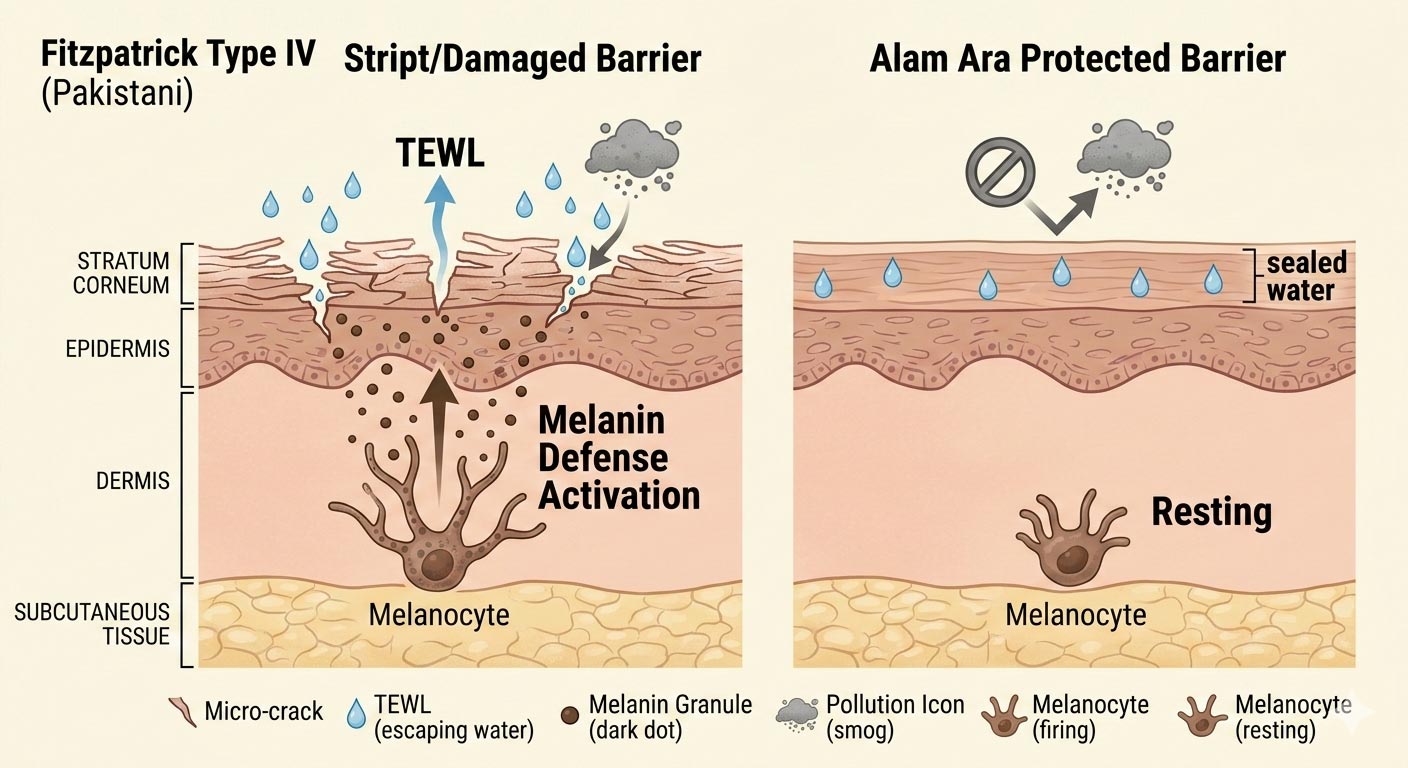
Harsh, high-pH surfactants — the kind dominant in Grade 3 bars — disrupt the acid mantle, the slightly acidic protective film sitting on your skin’s surface at roughly pH 4.5 to 5.5. When this mantle is repeatedly compromised, the skin triggers an inflammatory response. For South Asian and other melanin-rich skin types, inflammation does not present primarily as redness the way it does in lighter skin tones. It presents as hyperpigmentation.
This is clinically described as Post-Inflammatory Hyperpigmentation, or PIH. Melanocytes — the cells responsible for pigment production — respond to chronic low-grade irritation by upregulating melanin synthesis. You are not imagining the grayness. Your skin is producing more pigment as a defensive response to a product marketed as caring for it.¹
The cycle is insidious: harsh cleanser irritates skin, skin darkens in response, consumer purchases a brightening serum to address the darkening, continues using the same harsh cleanser that caused it. The r/PakistaniSkincare community is stuck in this loop, and it is being monetized at every turn.
The Glycerin Secret the Industry Deliberately Keeps
Here is where Grade 1 cold-process manufacturing becomes genuinely revolutionary rather than merely premium.
When fats and oils undergo saponification — the chemical reaction that creates soap — a natural byproduct is glycerin, a powerful humectant that draws moisture from the atmosphere into the outer layers of the skin. In large-scale commercial soap manufacturing, this glycerin is mechanically extracted and sold separately to cosmetics companies who repackage it in serums and moisturizers at significant markup. The bar soap itself is left glycerin-depleted: an efficient cleanser, stripped of the compound that would have made it genuinely beneficial.
Alam Ara’s cold-process method does not do this. By processing oils at low temperatures without industrial extraction, the glycerin remains distributed throughout the bar in its naturally occurring concentration. Every wash delivers not just cleansing but active moisture retention. Glycerin has been extensively documented in dermatological literature as one of the most effective humectants available, capable of improving skin hydration, barrier recovery, and surface texture with consistent use.²
Your skin’s water content is being maintained in the same action that removes impurities — which is, when you think about it, how a sophisticated skincare product ought to behave.
This is not a marketing claim. It is a straightforward consequence of process. Cold-process soap retains glycerin. Industrial soap does not. The Grade 1 standard combined with cold-process manufacturing is the difference between a cleanser that respects your skin’s biology and one that simply uses it.
Biomimetics: When Your Skincare Speaks Your Skin’s Language
The most elegant concept in modern cosmetic chemistry is biomimetics — the principle of designing ingredients that structurally resemble the skin’s own compounds so closely that the skin accepts rather than resists them.
Two ingredients deserve particular attention here. Jojoba oil is not technically an oil at all — it is a liquid wax ester with a molecular structure almost identical to human sebum. When it contacts skin, the sebaceous glands do not register a foreign substance demanding a response. They register a familiar lipid signal, which is one reason jojoba is extraordinarily well-tolerated across skin types and does not trigger comedone formation the way heavier plant oils sometimes can.⁴
Lauric acid, a medium-chain fatty acid found in high concentrations in coconut-derived ingredients, mirrors the lipid composition of the skin’s own barrier layer. It integrates into the intercellular matrix — the mortar between your skin cells — supporting the structural integrity of the barrier rather than merely sitting on top of it. Clinical literature also documents its antimicrobial properties against Cutibacterium acnes and common fungal strains, making it particularly valuable for South Asian skin prone to microbial imbalance in humid climates.⁵
These are not exotic additions. They are ingredients chosen because they speak the skin’s own biochemical language.
The Lip Pigmentation Problem Nobody Connects to Their Balm
This one requires a direct conversation. Lip darkening is extraordinarily common across Pakistani skin types and is almost universally attributed to sun exposure, genetics, or simply aging. These are contributing factors. But the daily petroleum-based balm being applied multiple times a day is frequently the unacknowledged accelerant.
Petroleum-derived occlusive agents do not moisturize. They seal. By creating an impermeable film over the lip surface, they prevent the lip tissue from accessing atmospheric moisture and gradually impair its natural moisture-retention capacity. More relevant to pigmentation: synthetic fragrances commonly added to commercial lip balms — listed variously as “parfum,” “flavor,” or individual fragrance compounds — are among the more well-documented causes of contact dermatitis on thin, fragile lip skin. And on South Asian skin, contact dermatitis means inflammation, and inflammation means PIH. Research into fragrance-induced contact sensitization has consistently identified lip cosmetics as a primary vector for perioral pigmentation in women of color.⁶
The solution is not to stop protecting your lips. It is to protect them with ingredients that function through biomimetic moisture delivery rather than occlusive sealing, and that contain zero synthetic fragrance compounds that the lip’s delicate mucous membrane tissue was never designed to absorb.
The Standard Is the Starting Point
Grade 1 is not a luxury designation. It is the minimum scientific threshold for a soap that is genuinely net-positive for your skin. Everything below it is, to varying degrees, a product working against the biology it claims to serve.
The skin concerns flooding Pakistani skincare communities are not inevitable. They are largely manufactured — created by a market that profits from the problem it sells the solution to. Understanding the Grade 1 standard, the glycerin retention mechanism, and the biomimetic principle gives you the vocabulary to evaluate every product making claims on your bathroom shelf.
Your skin is not difficult. It has just been given the wrong chemistry.
Alam Ara formulates exclusively to the Grade 1 standard, cold-processed to retain every molecule of naturally occurring glycerin. Because your skin deserves the science.
Scientific References
¹ Callender, V.D., et al. (2011). Postinflammatory hyperpigmentation. Am J Clin Dermatol.
² Fluhr, J.W., et al. (2008). Glycerol and the skin. Br J Dermatol.
³ Thiboutot, D., & Strauss, J.S. (2003). Diet and acne revisited. Arch Dermatol.
⁴ Pazyar, N., et al. (2013). Jojoba in dermatology. Giorn Ital Dermatol Venereol.
⁵ Rele, A.S., & Mohile, R.B. (2003). Effect of mineral oil, sunflower oil, and coconut oil. J Cosmet Sci.
⁶ Hamann, C.R., et al. (2019). Association between atopic dermatitis and contact sensitization. JAAD.
Frequently Asked Questions
Q: Why is Grade 1 soap considered the best organic soap brand in Pakistan?
A: Grade 1 is not just a marketing term; it is a PCSIR certification requiring 76% TFM. While many organic soap brands in Pakistan use fillers, Grade 1 ensures that the majority of the bar consists of skin-compatible fatty acids that promote skin barrier repair.
Q: Can natural soap bars help with oily T-zones?
A: Yes. By using biomimetic oils like Jojoba, our pure natural soap bars prevent the “rebound sebum” effect. This makes it the best soap for men in Pakistan who struggle with the oily nose/dry cheek paradox.
Q: Why does my face look dark after washing?
A: This is often PIH (Post-Inflammatory Hyperpigmentation). Low-grade soaps with high pH strip the acid mantle, causing melanin-rich skin to produce extra pigment as a defense mechanism. Switching to a high-TFM, glycerin-rich soap stops this inflammatory cycle.
Q: Is Grade 1 soap effective for men with oily or combination skin?
A: Yes. Men often face “Rebound Sebum,” where the skin produces excess oil because it has been over-stripped by harsh cleansers. By using a biomimetic ingredient like Jojoba oil (which mimics human sebum) in a Grade 1 soap, you signal to your skin that it’s already hydrated. This naturally balances the T-zone without causing the cheeks to become dry or flaky.
Q: Can my lip balm actually be making my lips darker?
A: Frequently, yes. Many petroleum-based balms and those with synthetic fragrances cause chronic micro-irritation on the thin skin of the lips. This leads to darkening over time. True lip recovery requires breathable ingredients like Organic Beeswax, Rosehip Oil, and Squalane, which repair the lip barrier structurally rather than just coating it in chemicals.
Q: How does the “Glycerin Secret” benefit dry or sensitive skin?
A: Glycerin is a natural moisture magnet (humectant) created during soap-making. Industrial soap brands strip this glycerin out to sell it separately in expensive lotions. Alam Ara uses the Cold-Process Method, which keeps 100% of the natural glycerin in the bar. This ensures your skin stays hydrated during the wash, rather than feeling like “sandpaper.”
Similar Posts
Turmeric Soap for Hyperpigmentation and Dark Spots: The Science Behind Natural Tyrosinase Inhibition
You’ve Tried Vitamin C and Acids, But the Dark Spots Remain. Why? Let me guess your skincare journey so far. You started…
The Smog & Chill Survival Guide: How to Winter-Proof Your Skin in Pakistan
Table of Contents The Science: What Winter and Smog Do to Your Skin The Alam Ara Winter Protocol When Winter Bites: Managing…
Pakistani Celebrity Skincare Secrets: Your Ultimate Guide to a Natural Glow
Table of Contents Mahira Khan’s Magic Mixture Dur-e-Fishan Saleem’s Family Secret The “Less is More” Philosophy From Celebrity Secrets to Your Daily…
Can Pakistani Women Really Get Korean Glass Skin? A Reality Check
The internet is obsessed with luminous, poreless Korean Glass Skin in Pakistan. This Korean skincare trend, born from intricate 10-step routines, has…
The Ultimate Dry Skin Rescue
A 3-Step Routine for Radiant Results Organic, clinical-grade formulas for skin that craves deep, lasting moisture Key Takeaways Fix the Barrier: Effective…
Best Organic Soap in Pakistan: Top 5 Brands (2026 Review & Price Guide)
The “Dirty” Truth: Soap vs. Detergent Most bars you buy at the supermarket in Pakistan are not actually “soap”—they are synthetic detergents….


